Switzerland and China have finished negotiating a revised free trade agreement that promises near-total duty-free access. Here is what has actually changed today, and what compliance teams still need to watch before it does.
The Headline
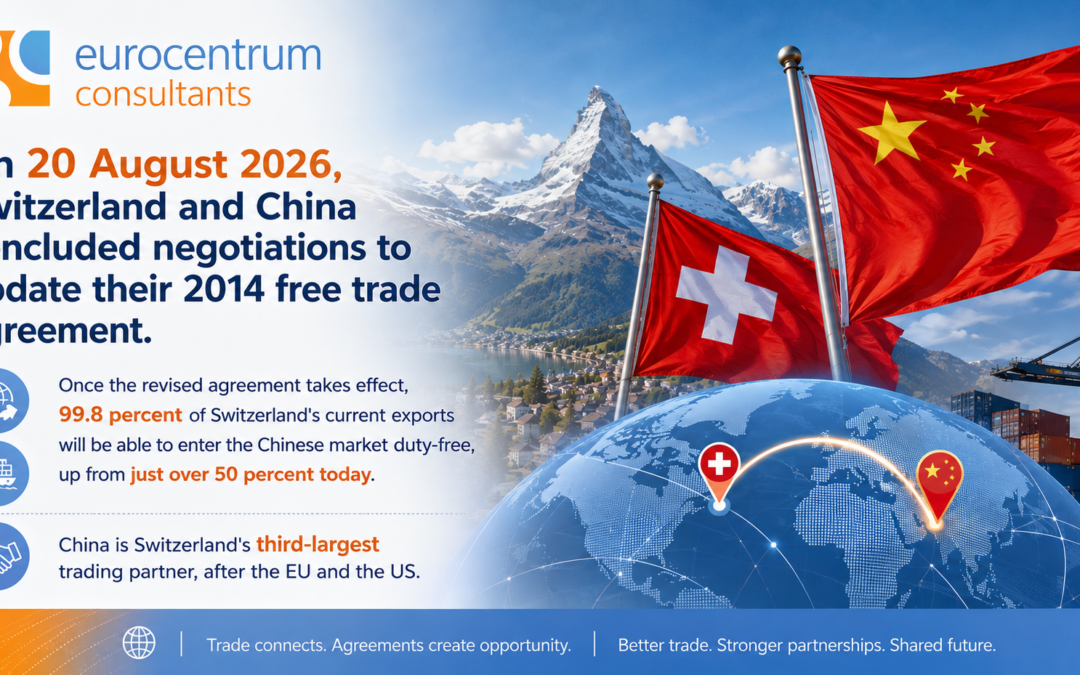
On 20 August 2026, Switzerland and China announced that they had concluded negotiations to update their existing free trade agreement (FTA). Once the revised agreement takes effect, 99.8 percent of Switzerland's current exports will be able to enter the Chinese market duty-free, up from just over 50 percent today.
That is a substantial widening of market access. It is also, for now, an agreement reached at the negotiating table, not a change in force at the border.
Where This Sits in a Longer Relationship
Switzerland and China's original FTA has a longer history than the headline suggests. Preparatory talks began in November 2007, followed by joint workshops with the private sector in 2009 and a joint feasibility study in 2010. Formal negotiations opened in 2011 and concluded in May 2013. The agreement was signed on 6 July 2013 and entered into force on 1 July 2014, alongside a separate agreement on labour and employment.
The 2026 announcement is an optimisation of that agreement, not a new one, reached after five rounds of talks that began in September 2024.
What the Revised Agreement Covers
The scope goes well beyond a tariff schedule. Alongside the duty-free access figure, the revised text updates rules of origin and trade facilitation, expands provisions on trade in services and digital trade, adds competition provisions, strengthens environmental and labour standards, and improves market access for Swiss investors.
China is Switzerland's third-largest trading partner, after the EU and the US, which gives the update practical weight beyond its symbolic value.
What Has Not Happened Yet
This is the detail most likely to be missed in headline coverage, and the one ECTM consistently flags for compliance teams: a negotiated outcome is not the same as an agreement in force.
Three steps remain before the revised FTA applies:
| 1. Legal review of the negotiated text. |
| 2. Formal signature, targeted for the end of 2026. |
| 3. Domestic approval procedures on both sides. |
No date has been announced for entry into force. The tariff reductions themselves, including the headline 99.8 percent figure, are expected to apply through phase-out periods rather than immediately on signature, and the detailed phase-out schedule has not yet been published.
Why the Sequence Matters as Much as the Number
Trade compliance teams have seen this pattern before, in both directions: political agreement first, operational detail later, sometimes considerably later. An agreement concluded is not an agreement in force, and an agreement in force is not the same as a tariff line already reduced to zero.
For businesses currently trading with China under the existing Switzerland-China FTA, the practical position today is unchanged. Today's rules, today's tariff schedule and today's rules of origin remain the ones that apply until the updated text is signed, approved domestically in both countries, and formally applied.
Three Actions for Compliance Teams Now
| 1. Continue applying the current Switzerland-China FTA terms. Nothing in the revised agreement is operative yet, and no interim transitional arrangement has been announced. |
| 2. Track the legal review and signature process rather than the headline figure. The signature date (targeted for the end of 2026) and any subsequent ratification timeline will be the events that actually start the clock toward entry into force. |
| 3. Once a phase-out schedule is published, check it tariff line by tariff line. A 99.8 percent duty-free outcome does not mean every product reaches zero duty on the same date. |
What Comes Next
Eurocentrum Consultants will continue to track the legal review, signature and domestic approval process for the revised Switzerland-China FTA, and will publish an update once a signature date, ratification timeline or phase-out schedule is confirmed.
If your organisation trades with China from a Swiss base, or is assessing how this update might affect origin planning or investment structuring, Eurocentrum Consultants and Grayston & Company are well placed to help.
Reach out via eurocentrumconsultants.com or write to us at info@eurocentrumconsultants.com to discuss your compliance needs.