In March 2026, the Council of the European Union and the European Parliament agreed on what has been described as the most significant reform of the EU Customs Union since 1968. This is not a technical update. It is a structural redesign of how trade oversight will function across Europe for the next two decades.
The reform creates an EU Customs Data Hub that will replace 27 national IT systems and more than 111 separate interfaces. It establishes a new EU Customs Authority based in Lille. It introduces a new Trust and Check trader status. And it abolishes the EUR 150 low-value duty exemption on small consignments, effective 1 July 2026.
For any business importing into or exporting from the EU, the question is not whether this affects you. It does. The question is whether you are ready.
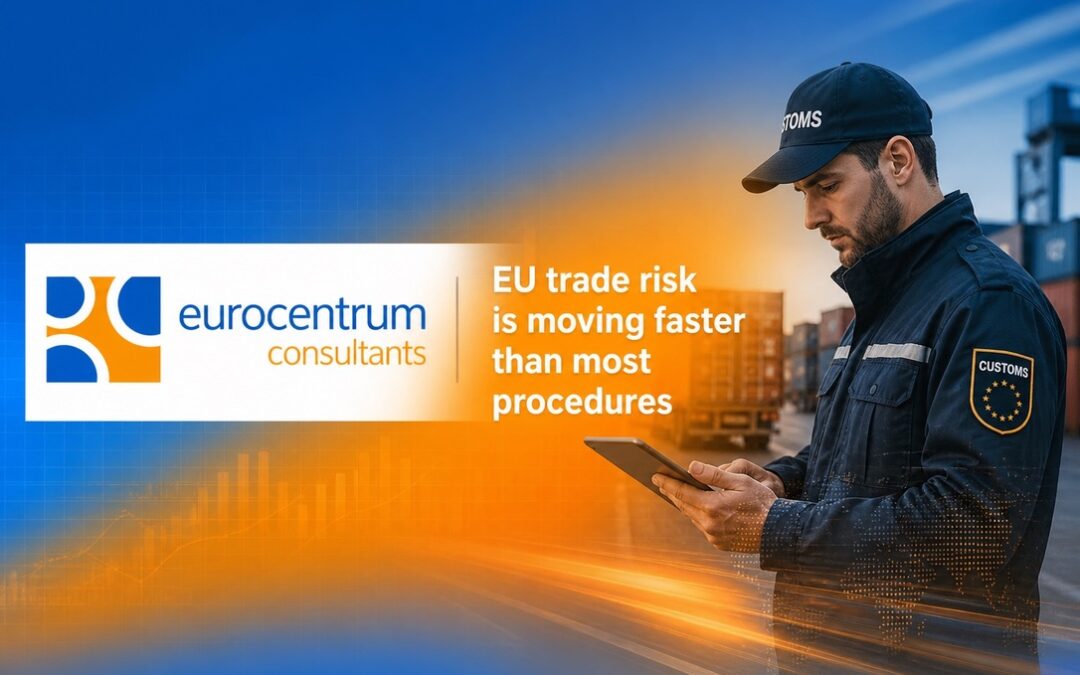
"EU trade risk is moving faster than most compliance procedures."
Why This Reform Happened Now
The EU customs framework that preceded this reform was built for a different era. The last major overhaul dates to 1968 - before global supply chains, before e-commerce at scale, before the geopolitical fragmentation that now defines international trade.
By 2025, the EU was processing a trade environment that had fundamentally outgrown the infrastructure designed to manage it. Nearly 5.9 billion low-value items are projected to enter the EU in 2025 alone, more than 90% originating from China. Each one passing through a patchwork of 27 national systems, with over 111 separate IT interfaces, inconsistent risk criteria, and enforcement intensity that varied significantly between member states.
The result was predictable: blind spots, administrative duplication, inconsistent compliance standards, and a system that was slow, fragmented, and increasingly exploited.
Three converging pressures made reform unavoidable:
- Volume of trade: Particularly low-value e-commerce parcels, which had overwhelmed legacy infrastructure.
- Geopolitical instability: From post-Ukraine sanctions enforcement to the 2026 Iran conflict, demanding faster, more coordinated risk management than fragmented national systems could deliver.
- Regulatory ambition: Expanded mandates such as CBAM, deforestation regulation, forced labour due diligence, and product safety requirements all depend on customs as an enforcement gateway.
A 1968-era system cannot carry that weight.
The Three Pillars of the Reform
Pillar One: The EU Customs Data Hub
The Data Hub is the architectural centrepiece of the reform. It replaces the fragmented national infrastructure with a single, centralised digital platform through which all importers, exporters, and intermediaries will submit customs and product data.
The operational logic is straightforward but transformative: instead of submitting declarations to 27 separate national portals, traders use one EU-wide interface. Data submitted once can be reused across multiple consignments. And every customs authority in every member state accesses the same shared, real-time data pool.
| What the Data Hub Actually Delivers | |
|---|---|
| Centralized Interface | One submission replaces 27 national portal filings. |
| Efficiency | Data reuse across multiple consignments eliminates duplicate administrative work. |
| Shared Intel | Every EU customs office accesses the same real-time view of goods movements and supply chains. |
| Proactive Security | Continuous data feeds replace episodic spot-checks. AI and machine learning screen incoming data to flag risks before goods arrive. |
| Financial Impact | Estimated savings: up to EUR 2 billion per year in national customs operating costs, and EUR 26 billion over 15 years for businesses. |
The phrase the Commission uses is worth noting: authorities will gain a "360-degree view of trade flows and supply chains." That is not a marketing formulation. It describes a genuine shift from episodic, declaration-based oversight to continuous, data-driven monitoring. Customs authorities will analyse shipment data as it flows in, not chase paper forms after the fact.
| Date | Implementation Timeline for the Data Hub |
|---|---|
| 1 July 2026 | EUR 150 low-value duty exemption abolished. Flat EUR 3 tariff (plus handling fees) on small consignments begins. |
| 1 July 2028 | Data Hub goes live for e-commerce parcels. |
| 2032 | Data Hub opens voluntarily to all other traders. |
| 2035 | Mandatory extension reviewed. |
| 2038 | Data Hub mandatory for all imports across all categories. Note: the original document cited 2034 as the full rollout date. This has been updated to 2038 following the March 2026 agreement. |
Pillar Two: Trust and Check Status
The Trust and Check status is a new category of authorised trader that goes significantly further than the existing Authorised Economic Operator (AEO) framework. It is designed for operators willing to offer full transparency in exchange for near-frictionless customs treatment.
A Trust and Check trader must equip their IT systems to transmit live tracking and shipment data directly to the Data Hub in real time. They must maintain robust risk management, compliance controls, and anti-fraud processes. They must demonstrate, through data, that their supply chain is under genuine governance.
| What Trust & Check Requires | What Trust & Check Delivers |
|---|---|
| Real-time electronic supply chain data transmitted to the Hub | Goods released into circulation with minimal or no customs intervention |
| Robust internal risk management and anti-fraud controls | Simplified declarations and pre-arrival processing |
| Full transparency of operations - customs access to electronic records | Deferred and periodically settled duty payments |
| Certified compliance systems with demonstrable audit trails | Bypass of transit and storage permit requirements |
| Ongoing performance against Trust & Check criteria | Single point of contact: one home member state customs office, regardless of EU entry point |
The phrase used in official Commission documentation is that Trust and Check traders can import goods with "minimal customs intervention." The most capable operators - those who can demonstrate full end-to-end supply chain transparency - may self-release goods entirely, with customs verification happening in the background through data rather than at the physical border.
The one-stop authority principle deserves specific attention. A Trust and Check trader will deal only with their home member state's customs office, regardless of where goods enter the EU. This is only possible because the Data Hub gives that single office a complete, real-time view of the trader's EU-wide activity. For multinationals and high-volume importers, this is a significant operational simplification.
For businesses that cannot yet meet the Trust and Check criteria, the existing AEO framework remains available and continues to offer meaningful simplifications. Trust and Check is not a prerequisite for all EU trade. It is the premium tier for those who invest in genuine compliance governance.
Pillar Three: The EU Customs Authority (EUCA)
The reform establishes a new EU Customs Authority, headquartered in Lille, France. EUCA is the institutional backbone of the new system. Its function is to manage the Data Hub at EU level, coordinate risk management across member states, and ensure that the uniformity the reform promises actually materialises in practice.
EUCA will set common risk criteria for the entire EU, issue control recommendations to national customs offices based on its analysis of Hub data, and work closely with Europol, OLAF, and Frontex on cross-border fraud, smuggling, and sanctions enforcement. It provides the oversight architecture that prevents any member state from becoming a weak link in EU customs enforcement.
The context here matters: before this reform, 27 administrations operated with approximately 111 separate IT systems with varying intensity. Businesses that understood the geography of EU customs enforcement could, and did, exploit the inconsistency. EUCA and the Data Hub are specifically designed to close that arbitrage.
The E-Commerce Dimension
The e-commerce provisions of this reform are among its most immediately significant - and most commercially disruptive - elements. They deserve specific attention from any business involved in cross-border online retail, marketplace operations, or low-value logistics.
The EUR 150 exemption is gone
From 1 July 2026, the EUR 150 low-value duty exemption that previously applied to small consignments entering the EU is abolished. In its place, a flat EUR 3 tariff applies to all sub-EUR 150 items, plus handling fees. This is not a gradual phase-out. It is an immediate and categorical change.
The Commission's own projections indicate that nearly 5.9 billion such items were expected to enter the EU in 2025, more than 90% from China. The exemption had become a structural arbitrage mechanism, entering the EU duty-free in a way never intended. That mechanism closes entirely on 1 July 2026.
| Immediate Action Required for E-Commerce Businesses | |
|---|---|
| From 1 July 2026 | EUR 150 duty exemption abolished. EUR 3 flat tariff plus handling fees applies to all sub-EUR 150 consignments. |
| Action Item 1 | Businesses selling into the EU via e-commerce platforms must review pricing, landed cost calculations, and consumer-facing communications now. |
| Action Item 2 | Any business model built on the EUR 150 exemption must be restructured before 1 July 2026. |
Platforms as deemed importers
The reform also changes the legal position of e-commerce platforms operating in the EU. Platforms are now treated as "deemed importers", making them responsible for customs duties and VAT on goods sold through their marketplaces. This is a significant shift in liability that mirrors developments already seen in VAT regulation.
Platforms must either hold AEO status themselves or appoint an AEO representative with an EU presence. Non-EU platforms selling into the EU are no longer shielded by the practical difficulty of enforcement. A customs handling fee will be imposed on platforms from November 2026. Consumers will no longer face unexpected hidden charges on delivery - the costs will be visible and allocated at the point of sale. Pricing and compliance responsibility completely shifts upstream.
Enforcement: From Random Checks to Continuous Monitoring
Perhaps the most consequential change for compliance professionals is the shift in how enforcement will actually operate. Under the old system, customs enforcement was episodic: random spot checks, post-clearance audits triggered by anomalies, and selective physical inspections at the border. Inconsistency between member states meant that risk could be managed partly through geography.
Under the new system, enforcement will be continuous. The Data Hub feeds a constant stream of trade data to EUCA and national customs authorities. AI and machine learning tools will screen that data to identify anomalies, unusual patterns, and risk indicators before goods arrive. The shift is from checking physical goods at borders to analysing data flows upstream of the border. Compliance is no longer about filing the right paperwork. It is about demonstrating the right governance.
The practical implications are significant. A business that has historically managed customs risk by ensuring declarations are formally correct may find that the new system flags issues their declarations never revealed:
- Classification inconsistencies across shipments.
- Valuation patterns that diverge from market norms.
- Origin claims that conflict with supply chain data.
EUCA will coordinate this monitoring at EU level, setting bloc-wide enforcement priorities. Member states will no longer be working with their own limited data sets; they will be working with the same pooled intelligence and will be expected to act on it consistently.
The reform also explicitly enables EUCA to share data with Europol, OLAF, and Frontex. This integration between customs enforcement and law enforcement agencies is deliberate. Sanctions evasion, fraud, and smuggling increasingly exploit the gap between commercial customs data and law enforcement intelligence. The new architecture is designed to close that gap.
What This Means for Your Business
The reform's business implications operate at three levels: immediate compliance obligations, medium-term operational restructuring, and longer-term strategic positioning.
Timeline of Structural Milestone Requirements
| Date | Change & Required Action |
|---|---|
| 1 July 2026 | EUR 150 low-value duty exemption abolished. EUR 3 flat tariff plus handling fees on all sub-EUR 150 consignments. E-commerce pricing models must be reviewed now. |
| November 2026 | Customs handling fee imposed on e-commerce platforms. Platforms operating in the EU must hold AEO status or appoint a qualifying representative. |
| 1 July 2028 | EU Customs Data Hub goes live for e-commerce parcels. Businesses in this sector must be ready to submit data through the Hub by this date. |
| 2032 | Data Hub opens voluntarily to all other traders. Businesses should begin assessing Trust and Check eligibility and data readiness well before this date. |
| 2035 | Mandatory extension review for Data Hub. |
| 2038 | Data Hub mandatory for all imports. All businesses must be integrated. |
Medium-term: Operational restructuring
The Data Hub and Trust and Check status together create a new incentive structure. The businesses that will benefit most are those that treat compliance as a governance capability, not a paperwork function. This means integrating trade compliance data with purchasing, manufacturing, and logistics systems, producing clear audit trails throughout the production and transit process, and investing in real-time tracking tools.
For logistics and warehousing providers, carriers and warehouse operators may become data hubs in their own right, feeding shipment data upstream to importers who need it for Hub submission. Contracts will need to be restructured to reflect these obligations. The Commission's target is a 25% reduction in the administrative burden on traders—achievable for businesses that invest in the right systems, but a significant added cost for those relying on fragmented, manual processes.
Longer-term: Strategic positioning
The Trust and Check framework is, at its core, a competitive mechanism. Businesses that qualify for Trust and Check status will move goods through EU customs faster, at lower administrative cost, and with less uncertainty. In high-volume, time-sensitive sectors—pharmaceuticals, electronics, perishable goods, just-in-time manufacturing supply chains—this difference will be commercially significant.
The question for most businesses is not whether to pursue Trust and Check status eventually, but when and how to begin building the compliance infrastructure that makes it achievable. Although the Data Hub does not go live for general traders until 2032, the internal systems, data governance processes, and supply chain visibility required take years to properly build.
The Sanctions and Export Controls Interface
The Data Hub's real-time, EU-wide data visibility will significantly improve the EU's capacity to enforce sanctions through the customs channel. Currently, sanctions evasion exploits the fragmentation between national systems: goods transiting through one member state may not be flagged at another. The Hub eliminates that arbitrage.
In the context of the 2026 Iran conflict and the rapidly expanding sanctions packages targeting Iranian oil networks, Chinese intermediaries, and Iraqi front companies, this matters immediately. Businesses in sectors with any exposure to sanctioned supply chains need to understand that the customs data they submit to the Hub will be screened against sanctions lists as part of the automated risk profiling process.
The reform also strengthens the enforcement of dual-use export controls. Continuous monitoring makes it harder to route controlled goods without detection. Classification decisions will be more visible, and inconsistencies will be easily flagged. The message for clients is clear: data submitted to the Hub will be cross-referenced across sanctions lists, export control databases, and other regulatory frameworks. Non-compliance in any single area will now be significantly more visible.
What Has Changed: Original Positions vs. Current Facts
A number of claims in earlier analysis of this reform have been superseded by the March 2026 agreement. The following table sets out the most important corrections:
| Aspect | Earlier Position | Current Position (May 2026) |
|---|---|---|
| Data Hub Rollout | Full rollout by 2034 | Mandatory for all imports by 2038, following voluntary phase from 2032 and 2035 review |
| Administrative Cost | Additional EUR 2bn per year in admin costs | Saves up to EUR 2bn per year in national customs operating costs |
| Low-value Exemption | Not addressed | EUR 150 exemption abolished from 1 July 2026; EUR 3 flat tariff plus handling fees |
| E-commerce Platform Liability | Not addressed | Platforms are deemed importers, liable for duties and VAT; AEO status required by November 2026 |
| EUCA Location & Role | Central coordinating body (general) | EU Customs Authority established in Lille; specific mandate to coordinate risk at EU level and work with Europol, OLAF, Frontex |
| Trust & Check Basis | New status building on simplified procedures | Formal authorized trader status building on AEO; requires real-time data transmission to Hub |
| Reform Significance | Technical update to customs framework | Described officially as the most significant reform since 1968 |
Questions That Remain Open
This reform is agreed in principle, but much of the implementation detail is still being determined. Businesses and advisors should track these live open points:
- AI safeguards and transparency: The reform endorses AI-driven risk profiling but does not yet specify the governance framework for those algorithms or how traders can challenge automated risk classifications.
- SME readiness: The data infrastructure requirements for full Hub integration may be disproportionately burdensome for SMEs. Dedicated support or transitional arrangements are not yet confirmed.
- Member state implementation consistency: The practical reality of 27 national customs administrations interpreting new rules will inevitably produce some early transitional divergence.
- Data sovereignty and security: Questions about who has access to this massive concentration of commercial supply chain data, under what circumstances, and with what safeguards remain unresolved.
- Interaction with green/regulatory frameworks: How and when enforcement for CBAM, deforestation regulation, and forced labour due diligence will integrate with the Hub is still being developed.
The ECTM Perspective & How We Can Help
At Eurocentrum Consultants, we have been tracking this reform closely since the original proposals in 2023. Our assessment is straightforward: This is not primarily a customs story. It is a trade governance story. Transparency has become a competitive asset, and real-time data is now the language of trust between business and regulator.
The firms we work with that are preparing well are already taking action. We can support your organization via:
Contact: info@eurocentrumconsultants.com | eurocentrumconsultants.com | Brussels & London