
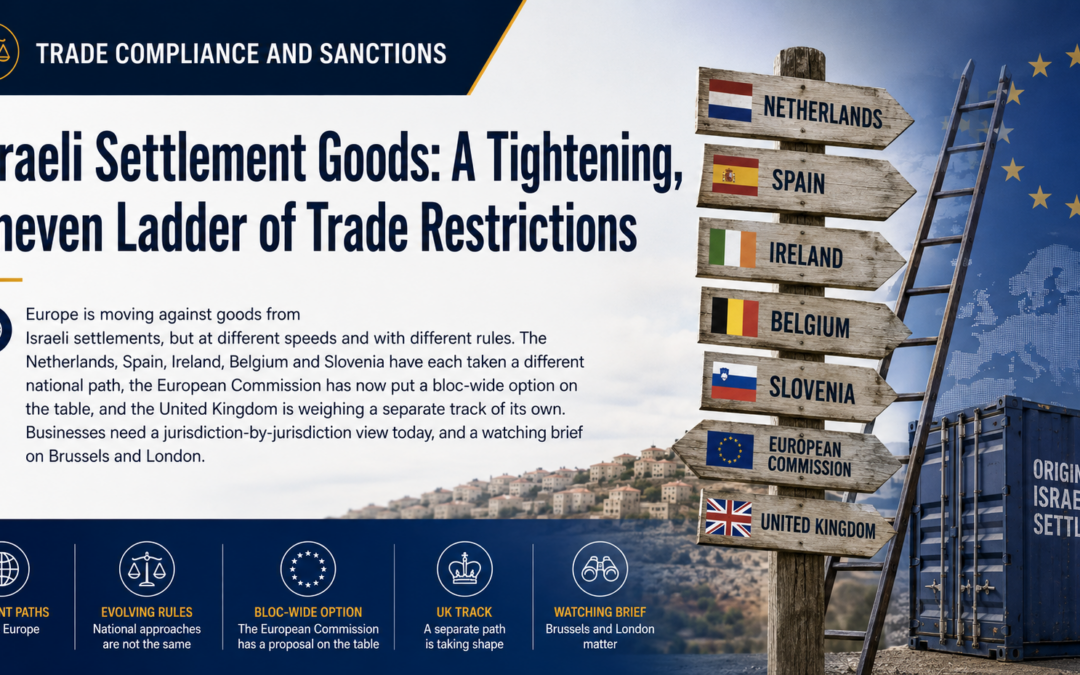
Europe is moving against goods from Israeli settlements, but at different speeds and with different rules. The Netherlands, Spain, Ireland, Belgium and Slovenia have each taken a different national path, the European Commission has now put a bloc-wide option on the table, and the United Kingdom is weighing a separate track of its own. Businesses need a jurisdiction-by-jurisdiction view today, and a watching brief on Brussels and London.
A new Netherlands measure, taking effect on 22 September 2026, prohibits the import, purchase and sale of goods originating in unlawful Israeli settlements in the occupied Palestinian territories and the occupied Syrian Golan Heights, together with services that facilitate that trade. It also prohibits brokering and circumvention of the ban.
The measure can prevent settlement-origin goods already present in the Netherlands from being purchased, offered or supplied commercially once it enters into force. Mere possession is not described as prohibited, but there is no transitional exemption: the explanatory memorandum confirms none exists, so businesses holding stock should not assume a grace period.
The Netherlands Measure in Detail
- Published in the Staatsblad (the Dutch Government Gazette) on 21 July 2026.
- Takes effect on 22 September 2026.
- Prohibits import, purchase, sale, brokering and facilitation services, and prohibits circumvention of the ban.
- Covers goods originating in unlawful Israeli settlements in the occupied Palestinian territories and the occupied Syrian Golan Heights, identified via the EU's settlement postal code list (see below).
- Applies to anyone operating in the Netherlands, and to Dutch natural and legal persons carrying out covered activities elsewhere in the EU. The brokering prohibition can catch a transaction arranged by a Dutch operator even where the goods themselves enter another EU member state.
- Introduces a new customs declaration requirement: importers releasing non-preferential Israeli-origin goods into free circulation must declare that the goods do not originate in a covered settlement, and should build supporting documentary evidence in advance.
- Is enforced as an economic offence under the Wet op de economische delicten (Economic Offences Act). Intentional breach can carry up to six years' imprisonment, community service or a fifth-category fine (currently up to €103,000); other breaches up to one year's detention or a fourth-category fine (up to €25,750). Goods may be confiscated and a business may face closure for up to a year.
- Sits alongside, rather than replaces, an existing Dutch policy of discouraging settlement trade that has applied since 2006.
- Expires automatically three years after entry into force, unless extended by an Act of Parliament.
- Businesses with implementation questions are directed to the Netherlands Enterprise Agency (RVO).
A practical question worth asking now: if your business holds stock that will become prohibited on 22 September, what is the plan for it? There is no grace period once the measure takes effect, so the options, redirecting the stock to another market before the deadline or writing it off, need deciding well before then, not after.
A Wider, Uneven Pattern Across Europe
The Netherlands measure is among the most extensive national measures adopted so far, extending beyond importation to purchase, sale, brokering and circumvention. Spain's measure is broader in a different respect, since it also restricts advertising for settlement-origin goods and services. Ireland's, by contrast, is confined to importation of goods. None of the five measures below is identical in scope, and one has already been reversed.
| Country | Import ban? | Additional scope beyond import | Legal basis and date | Status (25 Aug 2026) |
|---|---|---|---|---|
| Netherlands | Yes | Purchase, sale, brokering and facilitation services; new customs declaration requirement | Decree published in the Staatsblad, 21 July 2026 | Not yet in force. Takes effect 22 September 2026. Expires automatically after three years unless extended |
| Spain | Yes | Advertising of settlement-origin goods and services | Royal Decree-Law 10/2025, effective 24 September 2025 | In force |
| Ireland | Yes | None identified - goods import only | Act 2026, No. 35 of 2026, signed 23 July 2026 | Enacted. Not yet commenced as of 25 August 2026 |
| Belgium | Committed, not confirmed | Not specified in the available text | Federal government agreement dated 2 September 2025; summary published 5 September 2025 | [VERIFY] Implementation status not confirmed |
| Slovenia | No - reversed | Was goods import only | Introduced 6 August 2025; reversed around 11 June 2026 | Not in force |
Belgium's entry in this table is worth a second look. A government committing to a measure is not the same as the measure being in force. ECTM treats an item in this pipeline as confirmed only once it is verified against the primary legal instrument, not against a political announcement, and Belgium's implementation remains unconfirmed as this article goes to press.
The EU Postal Code List: The Operational Core of Every Measure
Every national measure above needs a working answer to one question: was this good actually produced in a settlement? The tool doing that work is not new. Since 2005, the European Commission has maintained a list of postal codes and localities in the West Bank, East Jerusalem and the Golan Heights that do not qualify for preferential tariff treatment under the EU-Israel Association Agreement, originally built so customs authorities could deny preference on settlement-origin goods declared as "Israel." The list has been updated repeatedly since, most recently in October 2025.
Spain, Ireland and the Netherlands are now leaning on that same postal-code logic as the practical mechanism for their new bans, rather than inventing a separate one. For a compliance team, that makes the list the first port of call for any origin check, not a footnote: if a settlement's postal code appears on it, goods carrying that code are not eligible for preferential treatment under the Association Agreement, and, increasingly, are not importable, saleable or advertisable at all in a growing number of member states. Keep a current copy, and check it against certificates of origin before, not after, a shipment moves.
The EU Dimension: A Bloc-Wide Option is Now on the Table
The most consequential open question is not any single national measure but whether the EU acts as a bloc. On 9 July 2026, the European Commission circulated a confidential options paper to member states, reported by Euronews before publication, setting out three possible approaches: an export licensing system, prohibitive tariffs, or a full or partial import ban. The Commission's own paper reportedly flagged that licensing and tariffs are both vulnerable to circumvention, while a ban would require customs officers to identify settlement-origin goods at the border.
The paper followed a request from at least 20 member states during Foreign Affairs Council discussions in June 2026, and an earlier joint letter from France and Sweden in April citing the International Court of Justice's 2024 advisory opinion on the illegality of the settlements. At the Council's 13 July 2026 meeting, foreign ministers debated the options; the EU's foreign policy chief, Kaja Kallas, said the import-ban option "got the most support." No decision was taken. Ambassadors were tasked with continuing the work, a possible extraordinary meeting was flagged, and the next scheduled Foreign Affairs Council sits in October 2026. Ireland, which held the rotating Council presidency at the time, and Spain were named as the measure's leading advocates.
Two sources of genuine uncertainty remain. First, timing: officials have given no date for a decision, let alone entry into force. Second, the legal mechanism: there is reported disagreement among member states and their lawyers over whether a trade restriction of this kind needs a qualified majority (15 of 27 states) or unanimity, which would set a materially higher bar. ECTM will treat an EU-wide measure as a live possibility to monitor, not as a scheduled event, until a formal proposal exists.
The UK: Guidance So Far, Not Yet a Ban
The United Kingdom sits outside the EU measures entirely and is on its own, separate track, one worth distinguishing carefully from an actual ban. In June 2026 the Foreign Secretary strengthened the government's business guidance, stating that British citizens and businesses should not conduct economic or financial activity in illegal Israeli settlements. That is advisory: it does not amount to a ban and carries no penalty for non-compliance. In July 2026 a Foreign Office minister confirmed the government was in discussion with partners on how a settlement trade ban might work, while also citing a number of unresolved technical difficulties. Parliamentary pressure for a binding ban is real and public, including a call from more than 60 MPs and peers, but as of 25 August 2026 the government has not announced legislation. A business trading in both the EU and the UK should not assume the two are moving in step, or on the same timetable.
Sanctions Are a Separate Legal Track
Separate from import bans, the EU maintains targeted sanctions against individuals and organisations linked to settler violence against Palestinians. On 28 May 2026, the Council of the EU listed four entities and three individuals under its Global Human Rights Sanctions Regime (Regulation (EU) 2020/1998), via Council Implementing Regulation (EU) 2026/1177. Those listed face an asset freeze, a prohibition on making funds or economic resources available to them, and, for the individuals, a travel ban. Reporting on the 13 July 2026 Council meeting noted that this listing became possible only after Hungary's newly elected government dropped an earlier veto in May 2026, a reminder that a single member state can hold an EU-level measure back until its own domestic politics shift.
This is a narrower and legally distinct tool from a national import ban. It targets named persons and entities, not all goods from a territory. For compliance purposes the two tracks should not be conflated. A supplier can sit entirely outside these sanctions listings and still be caught by a national import ban on settlement-origin goods, and the reverse is equally possible. A sanctions screen is not a substitute for an origin check, and an origin check is not a substitute for a sanctions screen.
Not a One-Way Ratchet
Slovenia banned imports of settlement goods on 6 August 2025, alongside an arms embargo and entry bans on named Israeli officials. The measure had little practical effect, since Slovenia recorded almost no such imports in the years immediately before it. In June 2026, a newly elected government reversed all three measures within days of taking office, citing a wish to restore normal political dialogue between the two countries.
The reversal is a useful corrective to any assumption that this is a one-directional trend. National positions on settlement trade can change with a change of government, and can change quickly. A compliance programme built only for today's rule in a given country risks being out of date within a single electoral cycle.
From Labelling to Liability: The Compliance Question
Until recently, the principal operational questions concerned origin labelling, preferential tariff treatment under the EU-Israel Association Agreement, and the territorial scope of that Agreement. Those questions have not gone away, but they have been joined by others that sit much closer to core trade-compliance disciplines: market access, sanctions screening and supply-chain due diligence.
Businesses may increasingly need to establish:
- Where goods were actually produced, checked against the EU postal code list, not simply whether the paperwork says Israel;
- Whether suppliers, intermediaries or beneficial owners appear on a sanctions list;
- Whether purchasing, brokering, advertising or resale of the goods is prohibited, not only importing them;
- Whether contracts and procurement policies contain territorial and sanctions clauses that are still accurate;
- Whether the same transaction is permitted in one jurisdiction and prohibited in another.
That last point deserves emphasis. A transaction lawful in one EU member state today may become unlawful in the Netherlands from 22 September 2026, and may become unlawful in Ireland once the relevant provisions of its 2026 Act are commenced. A compliance approach built for a single jurisdiction will not travel.
Enforcement is Becoming Real: A Live Example from Spain
The risk is not only being caught at customs. In August 2026, the Spanish consumer organisation CECU and the farming union COAG filed a formal complaint with Spain's Directorate General of Consumer Affairs, alleging that fruit and vegetables from the occupied Palestinian territories are being sold in Spanish supermarkets mislabelled as Israeli-origin, in potential breach of Royal Decree-Law 10/2025. The complaint's filing date was not stated in reporting seen on 25 August 2026, and the allegation is unproven at this stage. It illustrates a point worth stating plainly: enforcement of these measures is not solely a customs-border matter. Private organisations, consumer groups and farming associations are now actively watching supermarket shelves, and a mislabelling allegation carries reputational as well as legal risk, independent of whether a formal finding follows.
What This Means for ECTM Members
- Use the EU postal code list as your first origin-check tool. Keep a current copy, check it against certificates of origin before goods move, and treat a code that appears on it as a stop signal across every jurisdiction discussed here, not only the one your business happens to trade with today.
- Map exposure jurisdiction by jurisdiction. Identify every country where your business imports, sells, advertises or facilitates trade in goods that could originate in an Israeli settlement, and check each one against its current legal position, not against a political announcement.
- Strengthen origin verification using a risk-based approach. Do not rely automatically on an unsupported supplier declaration; obtain postal-code, production-location or other supporting evidence where the origin is unclear or the risk is higher.
- Screen counterparties and beneficial owners against current EU sanctions listings, as a separate exercise from any origin check.
- Review contracts and procurement policies for territorial and sanctions clauses that may already be out of date.
- Check for extraterritorial reach. The Dutch measure applies to Dutch persons and to brokering activity even when the goods themselves move through another EU country. Confirm whether your own trading structure carries similar exposure as other national measures are adopted or commenced.
- Watch Brussels and London as well as national capitals. A formal EU proposal, or a UK decision to move from guidance to legislation, would change the compliance calculus materially, and neither has a confirmed timeline as of 25 August 2026.
- Build a monitoring routine. Positions are moving in more than one direction, and a single change of government, or a single Council meeting, can shift a national or EU-level measure within days.
The central question for compliance teams is no longer whether a shipment is labelled correctly. It is now three narrower questions: has the business established the physical origin of the goods against the EU postal code list; has it screened counterparties and beneficial owners separately against current sanctions listings; and does its monitoring routine cover The Hague, Dublin, Madrid and Brussels, and now London as well. A business that can answer yes to all three is in a materially stronger position than one relying on a supplier declaration and last year's compliance manual.
A Note on Terminology
The terminology used in this article reflects the cited national measures and the position taken by the United Nations and the International Court of Justice, which most governments share. Israel disputes aspects of that legal characterisation.