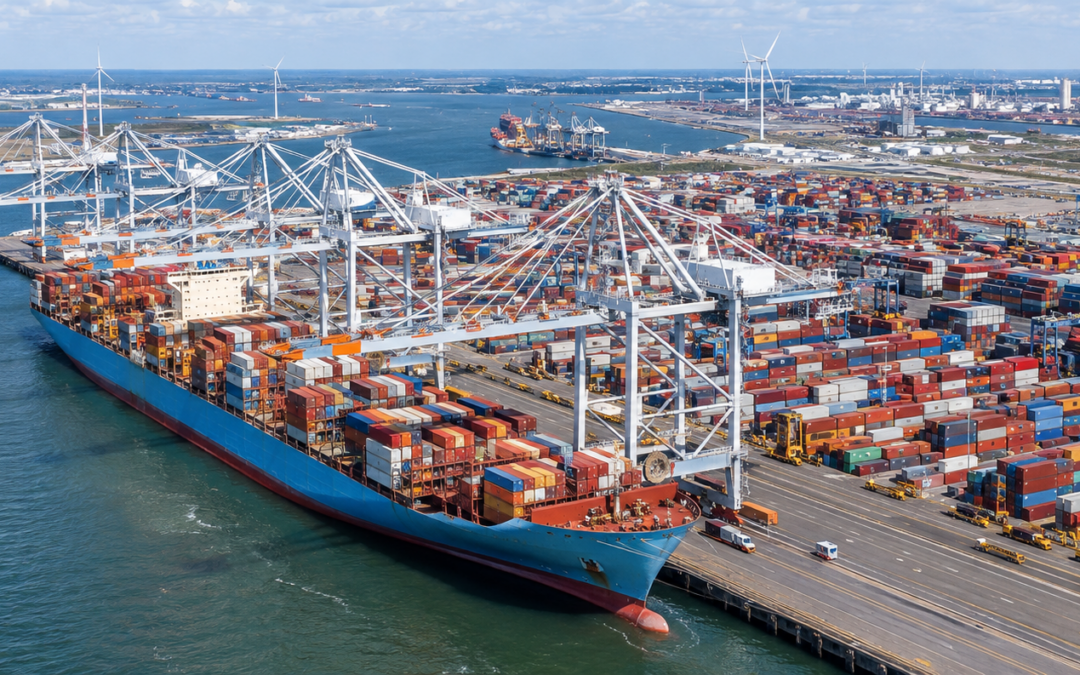
Rotterdam moves more freight than any other port in the European Union. The more useful story is not its size. It is how physical infrastructure, customs processes and shared data combine to move a single shipment through Europe's busiest gateway, and what that means for the people responsible for compliance.
Rotterdam, in One Verified Number
Rotterdam handled 397 million tonnes of freight in 2024, more than any other port in the European Union and equal to 11.8% of all freight tonnage moved through EU ports that year, according to Eurostat. That is more than Antwerp-Bruges (244 million tonnes) and Hamburg (97 million tonnes) combined.
Popular accounts often describe Rotterdam through dramatic claims about size, automation and Dutch dominance. A recent online video is one example, and a handful of its specific figures do not hold up under verification. The more useful story, and the one this article tells, is how physical infrastructure, customs processes and shared data actually move a shipment through the port, from arrival to onward delivery across Europe.
Three of the claims worth correcting are set out below. The full check, covering every claim in the source video, sits in ECTM's editorial working notes rather than in the published article.
| A claim worth correcting | What the primary sources show |
|---|---|
| Rotterdam handles more cargo than France and Germany combined | Not a meaningful comparison, it measures one port against two countries' entire port systems. The verifiable figure: Rotterdam handles 11.8% of all freight tonnage moved through EU ports, more than any other single port (Eurostat, 2024). |
| The port covers 12,500 acres | Wrong unit. The Port of Rotterdam Authority states the port covers 12,500 hectares of land and water, equivalent to roughly 30,900 acres, and stretches over 40 kilometres. |
| Maasvlakte II terminals run almost entirely without human hands | Misleading. Automation is extensive, remotely operated cranes, automated guided vehicles, automated stacking cranes, but the terminal still depends on people to operate systems remotely, maintain equipment and manage security. |
A Shipment's Journey Through the Port
To see Rotterdam's real advantage, it helps to follow a single container from arrival to onward transport. Each step depends on different information, different parties, and different points where a shipment can be held.
Step 1: Pre-arrival data
- Information needed: Advance safety and security data (an Entry Summary Declaration) filed before the vessel arrives, under the EU's Import Control System 2.
- Who relies on it: Dutch Customs' risk-analysis systems, the carrier, and the party responsible for the filing.
- What can hold it: A late or incomplete filing can trigger a risk flag before the vessel has even docked.
- What compliance controls: Accuracy and timing of the filing, and clarity over who in the chain is responsible for submitting it.
Step 2: Customs risk assessment
- Information needed: The import declaration, cross-checked against the advance data and other risk indicators.
- Who relies on it: Dutch Customs.
- What can hold it: Selection for document control, or for physical or non-intrusive scanning.
- What compliance controls: Classification accuracy, correct valuation and complete supporting documentation, submitted in advance rather than on arrival.
Step 3: Vessel and terminal handling
- Information needed: Container location and status, tracked in the terminal's own operating system.
- Who relies on it: The terminal operator, the shipping line, and hauliers booking a collection slot.
- What can hold it: Congestion, an equipment fault, or a container sitting in a scanning queue.
- What compliance controls: Little directly at this stage, but accurate advance data reduces the chance of a container being selected for scanning in the first place.
Step 4: Customs and commercial release
- Information needed: A customs release decision, which is separate from commercial release: the shipping line or its agent releasing the container once freight and other charges are settled.
- Who relies on it: Terminal, carrier, forwarder and consignee.
- What can hold it: A container can be customs-cleared but still held for unpaid charges or missing paperwork, or the reverse.
- What compliance controls: Understanding that customs release and carrier release are two separate approvals, not one event, and tracking both.
Step 5: Barge, rail, road or pipeline
- Information needed: An onward transport booking, linked to the same container and consignment references used earlier.
- Who relies on it: Inland operators, and the Portbase Port Community System that shares status across the chain.
- What can hold it: A booking made against a mismatched reference, or inland capacity constraints at a peak period.
- What compliance controls: Making sure consignment, container and transport references match across every system involved.
Step 6: European destination
- Information needed: Proof of onward movement and, where relevant, transit documentation.
- Who relies on it: The importer, any bonded warehouse or further customs office, and tax authorities.
- What can hold it: Missing transit documentation at the point of final release.
- What compliance controls: Closing the loop: confirming the shipment reached its declared destination and that the paperwork matches.
The Data and Customs System Behind That Journey
Being scanned and being cleared are not the same step. A container's route through customs typically runs through several distinct stages: submission of the import declaration; safety and security risk analysis, drawing on the advance data described in Step 1; document checks; selection, for some containers, for physical or non-intrusive scanning; a customs release decision; and, separately, release by the terminal and the carrier once their own conditions, commercial as well as regulatory, are met.
The Port of Rotterdam Authority reports that 95% of scanned containers at its Maasvlakte terminals clear customs within 36 hours of being unloaded, and that digitalising customs processing has cut turnaround times by 30% and complaints by 80%. These are Rotterdam's own reported figures, not an independently verified industry benchmark, but they describe a genuine shift from a paper-based process to a data-led one.
Portbase's Port Community System sits behind much of this. It is a shared platform, not a single owner of all the data: more than 6,000 companies and 15,000 users, spanning shipping lines, terminals, forwarders, shippers and inland operators, submit and reuse data through it under permission-based access, so that information supplied once does not need to be re-keyed at every handoff. Customs, terminal and carrier systems remain distinct behind that shared layer, and the practical risk in any such system is the same one every compliance team already knows: a mismatch between the commercial, customs and container-level records describing the same shipment.
Where Automation Helps, and Where People Remain Essential
Automation at the Maasvlakte II terminal is extensive: remotely operated ship-to-shore cranes, battery-powered automated guided vehicles, and automated stacking cranes. It is not staff-free. The terminal depends on people to operate systems remotely, maintain equipment, and manage security.
Automation changes the nature of the work rather than removing it. As container handling becomes more automated, maintenance, risk analysis, exception handling, safety oversight, cybersecurity and human judgement become more important to the system, not less.
How Cargo Leaves Rotterdam for Europe
Around 34% of the containers moving between the Maasvlakte terminals and the European hinterland travel by inland vessel, and inland container shipping to and from Rotterdam now exceeds 3 million TEU a year. Rail, road and pipeline complete the picture, each suited to different goods and different risk profiles.
Port efficiency means little if inland capacity, documentation or release processes fail further down the chain. A shipment cleared quickly at Rotterdam can still stall at an inland terminal, a rail yard or a bonded warehouse if the same data discipline does not carry through.
What Can Disrupt the System
- Cargo security: Rotterdam has been phasing out PIN codes for container release, a system vulnerable to fraud, through its Secure Chain programme. The 12 largest deep-sea shipping lines, representing 95% of deep-sea volume, have already moved to permission-based digital release; short-sea carriers are following through 2026.
- EU pre-arrival data rules: The Import Control System 2 has required advance safety and security declarations from maritime carriers since mid-2024, with full coverage phased in across all transport modes through 2025. It is part of a wider EU shift toward earlier, data-led risk assessment, and it is the source of the pre-arrival data referenced in Step 1 above.
- Data mismatch and system resilience: A port that runs on shared data is exposed to what happens when that data is wrong, late or unavailable, whether from human error, a system outage or a cyber incident. Shared visibility reduces this risk but does not remove it.
- Chinese state investment in European ports: State-owned COSCO holds a 35% stake in Hamburg's Container Terminal Tollerort and a controlling stake in Greece's Piraeus Port Authority, part of a wider pattern that has become a live topic in EU economic security policy. This is a real development to track, not evidence of a strategy aimed at Rotterdam specifically.
- Red Sea rerouting: Houthi attacks have pushed many shipping lines to reroute around the Cape of Good Hope since late 2023, adding one to two weeks to typical Asia-Europe voyages and creating scheduling disruption that reaches every major European port, Rotterdam included.
- Rising sea levels: A long-term risk the Netherlands takes seriously: the government's Delta Programme commits ongoing investment in coastal and river flood defences through the middle of this century.
Five Questions for Compliance Teams
| 1. Which European gateways handle our highest volumes? |
| 2. Which party submits each required dataset, and when? |
| 3. Can we connect declaration lines to the relevant shipment, container and commercial records? |
| 4. What happens when customs release, carrier release and terminal release do not occur together? |
| 5. Do we have a workable alternative route if the normal port or inland corridor becomes unavailable? |
A History Worth Acknowledging, Briefly
The VOC, in brief
Rotterdam's commercial instinct predates the modern port by four centuries. The Dutch East India Company, the VOC, was founded in 1602 as the world's first company to issue tradable shares to the public, and the Amsterdam Stock Exchange was created to trade them, a genuine foundation of modern capital markets.
That same company sustained its position through colonial violence. In 1621, under Governor-General Jan Pieterszoon Coen, VOC forces besieged the Banda Islands to seize control of the nutmeg trade. An estimated 2,500 people died of starvation and deprivation during the siege, hundreds more died fleeing or fighting, and most of the surviving population was deported or enslaved to work the plantations that replaced them. Dutch commercial innovation and colonial coercion were not separate stories. Both belong in any responsible account.
What This Tells Trade Compliance Teams
Rotterdam's strength does not come from cranes and geography alone. It comes from connecting infrastructure, customs, data, security and inland transport into one operating system. For businesses, the lesson is straightforward: trade compliance works best when it is built into the movement of goods, not added after the shipment has begun.
What Comes Next
How Trade Actually Moves will continue with other places and systems that shape global trade, including Antwerp-Bruges, Singapore, the Rhine corridor and the EU customs data systems that link them together.
Do you know where your European supply chain depends on a single port, system or data handoff? Eurocentrum Consultants can help map the points where logistics, customs and compliance meet. Reach out via eurocentrumconsultants.com or write to us at info@eurocentrumconsultants.com.