
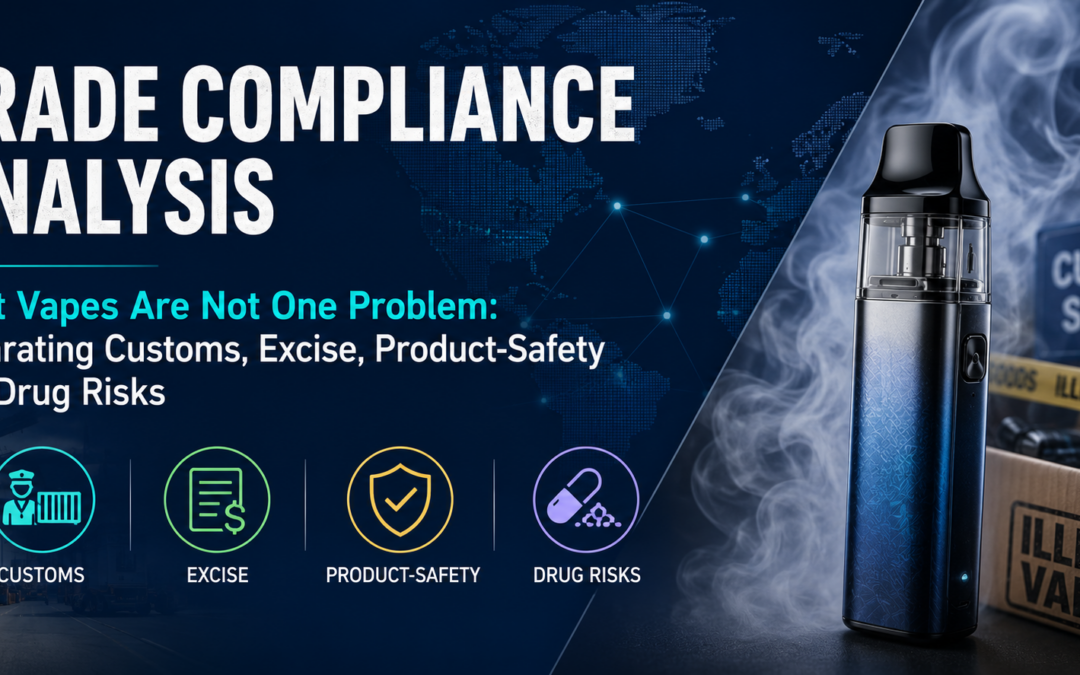
"Illegal vape" is not one problem. It is at least six, and treating them as one produces poor regulation, poor reporting and poor compliance.
As the UK's new Vaping Products Duty and duty stamp scheme take effect (see our companion briefing, "UK Vaping Products Duty: Eight Actions Businesses Must Take Immediately Before 1 October 2026"), enforcement agencies across several countries are reporting a related but separate trend. Enforcement activity is intensifying, and recent operations demonstrate links with wider criminal activity, including, in some cases, devices containing dangerous psychoactive substances. The two stories are connected but distinct, and confusing them serves no one.
Six Problems Wearing One Name
When a vape is described as "illegal," it is usually one of six different things:
- Single-use vape restriction: A single-use vape whose sale or supply has been prohibited in the UK since 1 June 2025.
- Regulatory non-compliance: A product that breaches composition, strength, tank-capacity or notification rules under the Tobacco and Related Products Regulations.
- Duty stamp violation: A product without a valid duty stamp where one is legally required, taking account of duty-suspension and transitional arrangements.
- Intellectual property or excise fraud: A counterfeit product, which is an intellectual-property matter, or a product carrying a counterfeit duty stamp, which is excise fraud; the two are legally distinct.
- Customs or import offense: A customs or import offence, involving misdeclaration, undervaluation, incorrect importer information, prohibited goods, or unlawful diversion from duty suspension, whether or not the product itself would otherwise be lawful.
- Contaminated or drug-laced device: A device containing controlled or otherwise dangerous psychoactive substances, rather than, or as well as, nicotine.
Customs, excise, VAT, product-safety, environmental and criminal law can all apply, sometimes to the same seizure at once. A single enforcement operation can report a "vape seizure" that is actually several of these at once, layered on top of each other. Reporting that does not identify which of the six is involved will confuse the market rather than inform it.
The customs dimension is often the least visible, but the evidence for it is strong. OLAF's JCO VAPE operation found e-cigarette consignments misdeclared under a wide range of unrelated goods categories, including toys, towels, clothing, shoes, shelves, earphones, glass cups and essential oils, with no single predominant category. That pattern, deliberately avoiding any one description to evade detection, is itself evidence of organised customs fraud, independent of whatever the product inside turns out to be.
Is the Illicit Market Really Increasing?
Enforcement activity is intensifying, and recent operations demonstrate links with wider criminal activity. Seizure figures do not, on their own, measure the total size or growth of the illicit market. A larger number of seizures can reflect a genuinely larger illicit market, but it can equally reflect more enforcement resource, better detection, a small number of unusually large consignments, or a change in the legal definition, such as the UK's single-use ban reclassifying products that were previously sold lawfully.
674 tonnes of e-cigarettes seized worldwide. E-commerce accounted for 44.8% of all cases in the WCO's illicit-trade database overall, a figure covering illicit trade of every kind, not vaping specifically. The WCO is explicit that this is not a complete measurement of global illicit trade.
The first multinational customs operation focused specifically on e-cigarettes and heated tobacco products ran across 30 countries, seizing over 1.9 million e-cigarettes (1.7 million in Belgium, the largest national haul), nearly 61,000 heated tobacco products and 1,551 units of e-cigarette liquid.
National Trading Standards reported in March 2025 that it had seized over one million illegal vapes in the previous year, alongside 19 million counterfeit cigarettes and over 5,100 kg of illicit hand-rolling tobacco. Government has since committed £10 million to fund around 80 additional enforcement officers. Kent's Trading Standards teams separately report three million illegal vapes stopped over five years to January 2026; this may overlap with the national figures above and should not be added to them.
A one-week National Police Chiefs' Council operation produced 362 arrests, most connected to organised immigration offending, alongside over £700,000 in seized illegal tobacco, cigarettes and vapes combined, over £1 million in cash, and £131,000 of drugs. The release does not break out how much of the £700,000 related to vapes specifically, or establish that those arrested were themselves supplying vaping products; vape shops were named as one of several high-street business types used as cover, alongside barbers, car washes and nail salons.
The Australian Border Force reports over 13.2 million illicit vaping products seized at the border, a 112% increase on the prior year. A separate, alleged New South Wales criminal network is reported to have had 282,654 vapes seized across two operations, alongside firearms, a controlled precursor chemical, luxury goods and frozen assets exceeding $25 million; charges have been laid but not tested in court. A related but distinct illicit-tobacco investigation, covered in the same release, uncovered a further A$690,000 in cash.
These figures cover different periods, jurisdictions, product definitions and enforcement methods. They are not directly comparable and should not be combined into a global market estimate.
No dependable official estimate of the proportion of UK vaping consumption that is illicit currently exists. Industry-commissioned figures exist and are sometimes quoted; they should not be treated as neutral market measurements.
The Contents Problem Is Real, and It Is Separate Again
Distinct from questions of duty, customs and counterfeiting, there is credible evidence that some illicit devices contain controlled or dangerous substances rather than, or as well as, nicotine.
- The College of Policing reports that illicit devices encountered around schools can contain THC, synthetic cannabinoids such as Spice, and ketamine.
- University of Bath testing of 596 confiscated school vapes found Spice in devices from 28 of the 38 participating schools (74%), in 16.6% of the devices tested overall, and THC in around 1% of devices. These were confiscated products from selected schools that took part because of existing concerns; the results demonstrate a genuine risk but are not a nationally representative prevalence estimate. A separate, smaller trial of 215 vapes from schools in one East Lancashire town found 29% contained a controlled substance.
- Trading Standards testing in Devon, Salford and Berkshire found nicotine in 10 of 76 products sold as "nicotine-free," with concentrations reaching 27.02 mg/ml. All ten also exceeded the legal limit on e-liquid volume, and two exceeded the statutory nicotine-strength limit as well.
- The Advisory Council on the Misuse of Drugs has warned that limited testing of seized liquids means the true availability of etomidate is likely significantly underestimated. Etomidate is not yet a controlled drug: government has accepted the recommendation to control it under the Misuse of Drugs Act and says it will legislate when parliamentary time allows, but implementation had not taken place as of this briefing.
Drug-laced pods and illicit nicotine vapes can share distribution channels, but they are not the same offence, the same risk, or the same regulatory response.
The Market and Policy Backdrop
Regular vaping among adults appears to be a genuinely growing habit, not only an enforcement story, though the figures cover lawful and unlawful vaping together and cannot be used to demonstrate illicit-market growth specifically. OECD data show regular e-cigarette use, defined as at least monthly among people aged 15 and over, roughly doubling across countries with comparable data, from around 3% to around 6%, between 2016 and 2023; the OECD itself cautions that sample sizes and definitions vary between countries. The European Commission has also proposed the EU's first harmonised minimum excise rates for e-liquids, at 20% of retail price or €0.12 per ml for nicotine strengths up to 15mg/ml, and 40% of retail price or €0.36 per ml above that, intended to apply from 2028. The European Parliament adopted its position in June 2026; the proposal is awaiting a final Council decision and is not yet law.
What This Means for Lawful Operators
For lawful manufacturers, importers and retailers, the common starting point is the same: reliable evidence and clear ownership of each control. The specific response then depends on which risk is in play: product compliance, customs declaration, excise and stamps, intellectual-property authentication, or suspected controlled drugs. Our companion briefing, "UK Vaping Products Duty: Eight Actions Businesses Must Take Immediately Before 1 October 2026," sets out what to do before the new duty takes effect.
How Eurocentrum Consultants Can Help
Eurocentrum Consultants' Vaping Duty Readiness Review examines product scope, approvals, stamps, duty-suspension flows, import responsibilities and supporting records before weaknesses become border, warehouse or enforcement problems. If you are planning ahead, register your interest now in our Q1 2027 webinar on excise duty and vapes, or contact us at info@eurocentrumconsultants.com.